
View Results from a Previous Test Run
AIQ
View storesResults the results of every test, every step, and every failure tofrom a ResultsPrevious RepositoryTest (normallyRun
Use previous test run usingresults to compare baselines, investigate past failures, and track performance trends over time. Confirm that the Analyzecompared buttonsruns fromused the Startsame Screen.environment, Resultsscenario Analysisversion, Reportsdata displayassumptions, and load model before drawing conclusions.
Recommended workflow
- Locate the
resultsrun by project, suite, execution date, or execution ID. - Open the completed result and review summary status first.
- Compare key metrics or failed steps against the current run.
- Record relevant links or execution IDs in
athebrowser-basedrelatedWebdefect,pagereport,byormakingmaintenancelivenote.
Comparison tonotes
- Avoid comparing runs that used different environments or data sets unless that difference is the
Results Repository.AIQ keeps the results by execution. Each time you click the Play button in a Controller, or a Continuous Integration environment like Hudson, Jenkins, or Bamboo, execute a test AIQ stores a new execution.Choose an execution, click the Analyze button, and a new browser window appears displaying the list of Reports for the chosen execution.Printing Reports and ChartsAIQ presents the results in a set of Web pages. Use your browser's Print command to print reports.ConfigurationAIQ uses a relational database (RDBMS) for its Repository. AIQ logs every test operation, test step, and monitored resource to the Repository. AIQMySQLandOracle. ContactIQ Global Servicesfor support ofIBM DB2andMicrosoft SQL Server. For information, see Repository configuration in Appvance IQ.
analysis.AIQ builds its own database schema to store the logs. The DB contains a catalog of scenarios (scenario, use-cases, and steps) and tables to store the results of executions (executions, transactions results, steps times). Use the Global Options link from the Start Screen, Navigate to the Preferences tab, Click Results under Preferences - Download SQL - to receive a copypoint of theschema. - Use
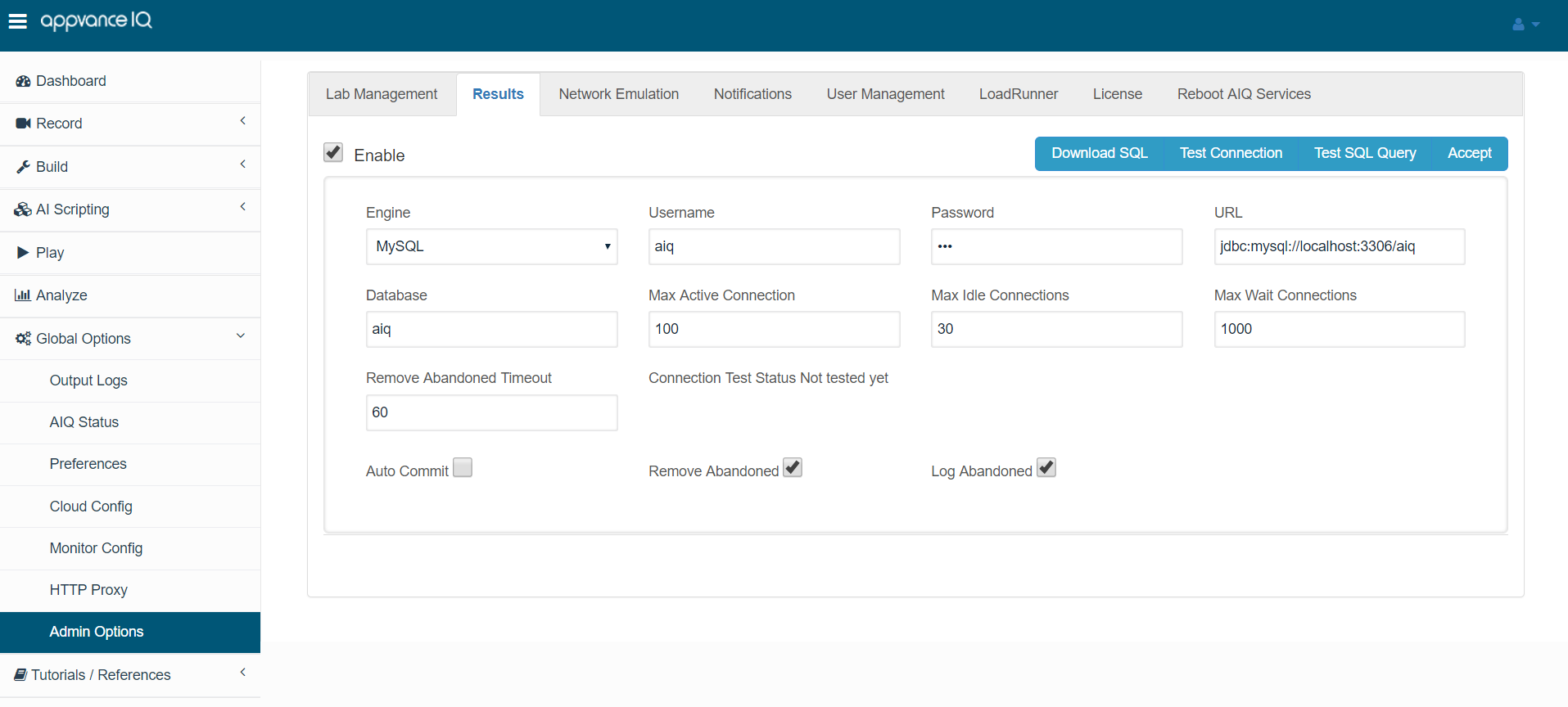
Database administrators use the Download SQL button to populate a database with the AIQ tables. For example,periods forMySQLperformanceusers, after creating a user account and granting ALL privileges to the user, enter the Username, Password, URL (in the format of jdbc:mysql://localhost:3306/aiq,) and choose the database type. Make sure the URL does not include the AIQ database path. Click Result Schema. View the Output panel forcomparisons. - Document any
errorscenariomessages.orThenapplicationaddchangesthebetweenutp name to the URL (jdbc:mysql://localhost:3306/aiq) and click Accept.runs.
MySQL database administrators who run MySQL in Unix and Macintosh operating environments must start the database with the --lower_case_table_names=1 option. Without this option, the Results Analysis Engine encounters SQL syntax errors when MySQL processes AIQ's reports-related queries.
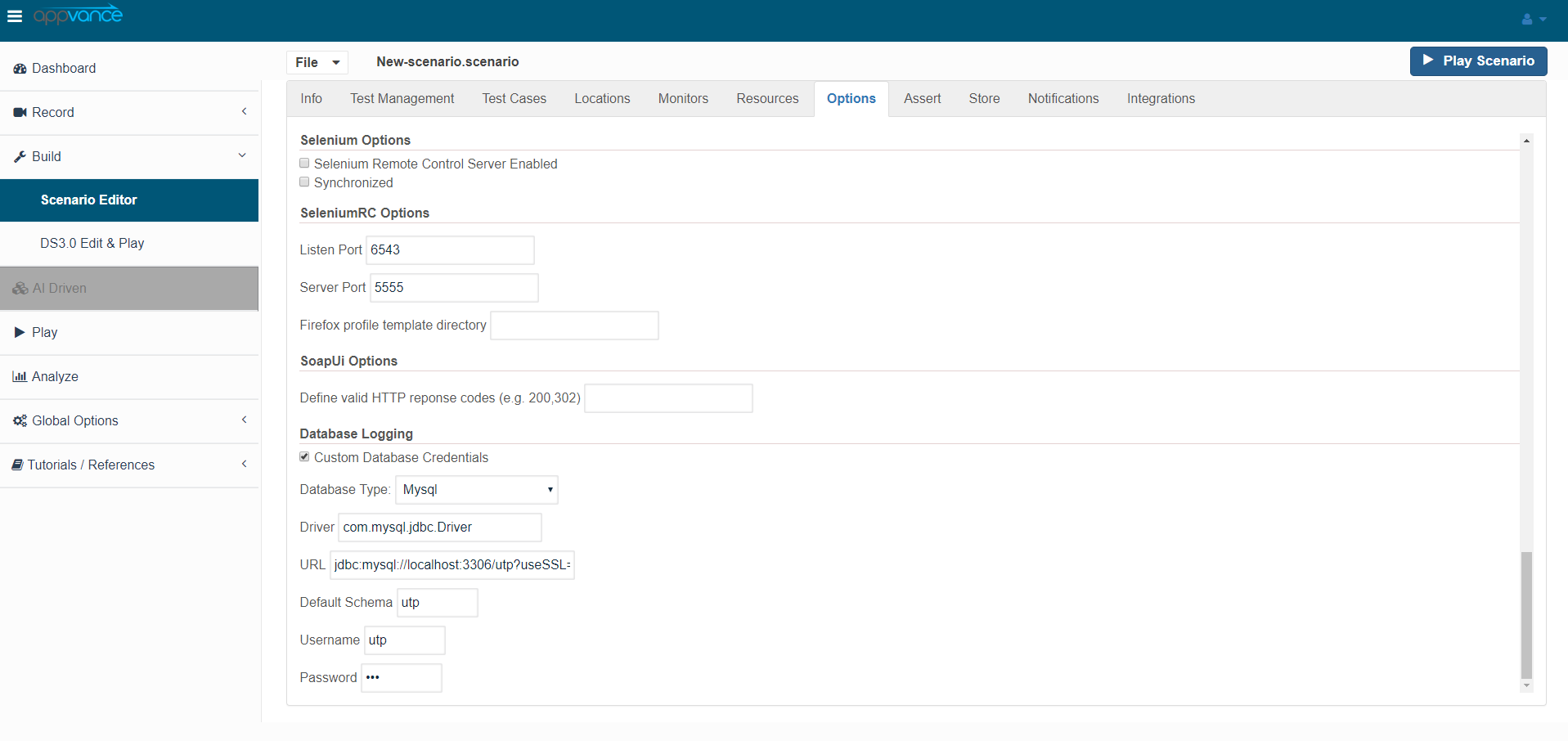
You must also change your Test-scenario to log to the correct repository. Use the Options tab in the Scenario Builder to change the repository location.
Last updated: JuneSeptember 26,18, 20232026
If you have any feedback on this topic, please contact us at documentation@appvance.ai